
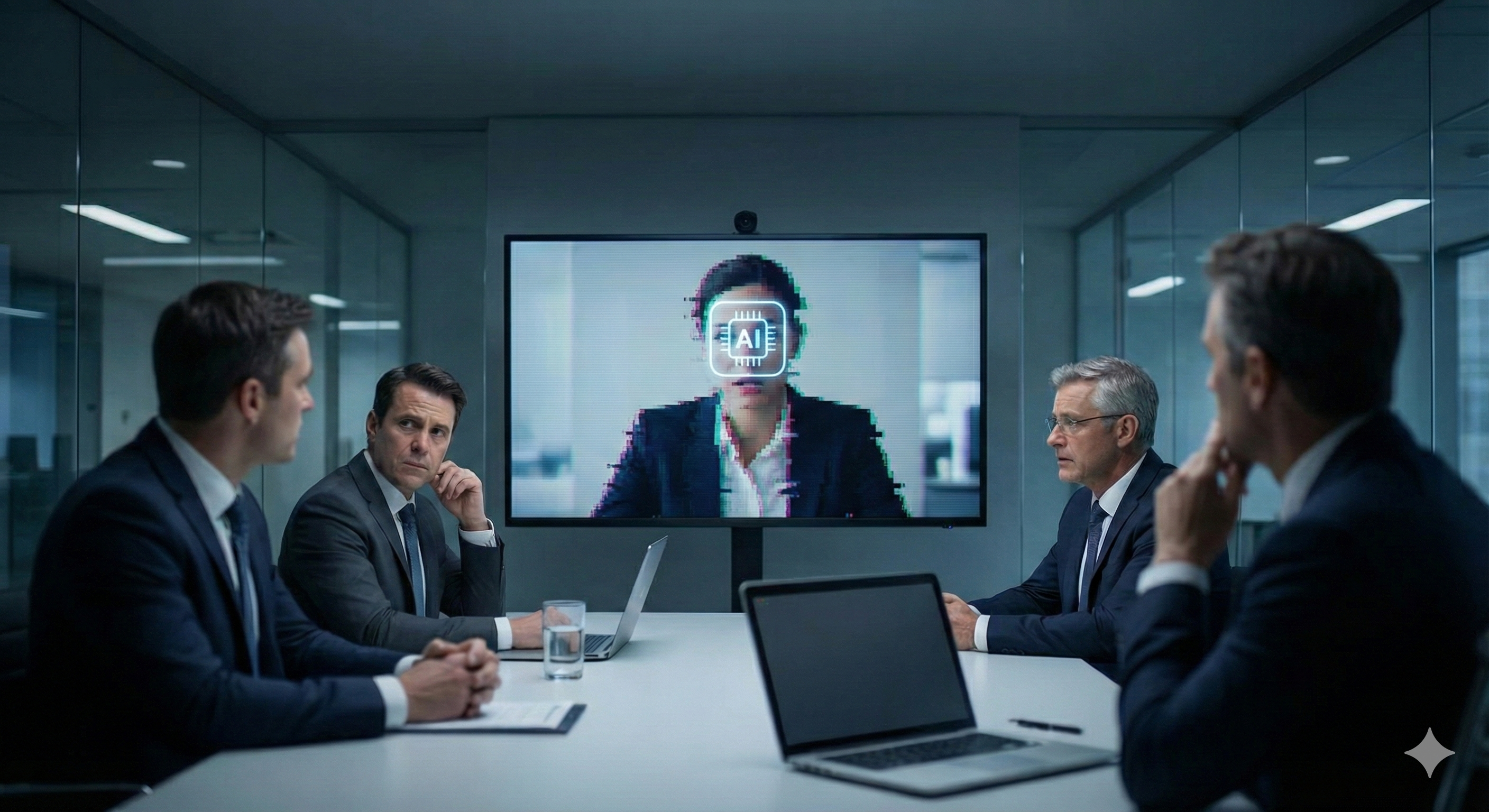
The Crisis of Authenticity: When Agentic AI Joins the Boardroom Call
In the financial sector, “seeing is believing” is no longer a viable security posture. How do we defend against real-time executive impersonation powered by autonomous AI?
The scenario is a financial CISO’s nightmare, and by 2026, it has moved from theory to reality.
A regional bank’s CFO receives an urgent calendar invite for a video call with the CEO and external legal counsel regarding a time-sensitive acquisition. The CFO joins the Teams or Zoom call. The CEO is there. The voice, the distinct mannerisms, the slight impatience when discussing regulatory hurdles—it’s flawless. The “CEO” instructs the CFO to execute an immediate, nine-figure wire transfer to an escrow account to secure the deal.
The CFO hesitates slightly, citing protocol. The “CEO” on the screen reacts in real-time, expressing frustration and providing a plausible, confidential reason for bypassing standard procedure. The CFO, under pressure from the face and voice they have known for a decade, authorizes the transfer.
The money is gone. The CEO was never on the call.
This is not traditional “CEO fraud” or a sophisticated phishing email. This is the weaponization of Agentic AI—autonomous systems capable of pursuing complex goals—combined with real-time, hyper-realistic deepfake technology. For the financial industry, where trust and identity are the bedrock of every transaction, this represents a fundamental crisis of authenticity.
The Evolution of the Threat: From Static to Agentic
For years, financial institutions have trained employees to spot the telltale signs of business email compromise (BEC): urgent requests, slight misspellings in email addresses, or unusual wiring instructions. We built defenses against static deception.
The threat has now evolved into dynamic, interactive deception.
We are moving beyond simple “deepfakes”—pre-recorded videos swapped onto a screen. We are facing AI Agents driving synthetic personas. These systems do not just mirror a face; they ingest real-time audio from the call, process the context using Large Language Models (LLMs), generate a relevant, in-character response, and animate the synthetic video and voice model to deliver that response instantly.
They can handle objections. They can “read” the room. They can simulate human frustration or urgency.
For financial institutions, the danger lies in the authorization chain. High-value transactions—M&A activity, massive institutional trades, treasury movements—often rely on verbal confirmation between trusted senior executives as the final fail-safe. Agentic AI has successfully hacked that fail-safe.
The Failure of Sensory Validation
The critical vulnerability today is not technological; it is biological. Humans are hardwired to trust what we see and hear from people we know.
Our current security awareness training is rapidly becoming obsolete. Telling employees to “verify urgent requests” is meaningless when the verification happens on a video call with a flawless duplicate of the requestor. If a branch manager sees their Regional Director on screen giving a direct order, their brain is conditioned to comply.
In the era of Agentic AI, sensory validation—trusting your eyes and ears—is a security vulnerability.
The New Defense Paradigm: Identity-First Security
If we cannot trust the video feed or the audio stream, what can we trust? The financial industry must pivot immediately to a “Zero Trust” model for human identity in digital channels. We must assume that any digital representation of a human could be synthetic until proven otherwise.
This requires moving from sensory validation to cryptographic validation.
1. Cryptographically Signed Corporate Identity
Just as we use SSL/TLS certificates to verify that a website is genuine, we need enterprise-grade mechanisms to verify that the person on a video call is genuine.
Financial institutions must aggressively push for and adopt emerging standards that bind a verified corporate identity to a live video session. When a CEO joins a call, their feed should carry a cryptographic assertion—visible as a verified “check mark” or similar indicator in the collaboration platform—proving that the stream is originating from their authenticated device and biometric profile, not an AI injection. If the cryptographic signature is missing, the participant is untrusted by default.
2. Liveness Detection vs. Deepfake Detection
We cannot rely solely on software designed to “spot” deepfakes. AI detectors are already in an arms race with AI generators, and the generators are winning.
Instead, defense must focus on active liveness detection. This involves challenge-response mechanisms during high-stakes calls that an Agentic AI would struggle to replicate in real-time without detectable latency or artifacts. This could involve subtle, randomized prompts requiring specific physical interactions that current real-time models find difficult to process flawlessly.
3. The Mandatory Out-of-Band (OOB) Protocol
The most immediate defense is procedural. Financial institutions must rewrite their authorization protocols to state that no voice or video communication alone is sufficient for high-value transactions.
If the CEO on a video call demands an urgent wire transfer, the protocol must require a concurrent, out-of-band verification. This could be a push notification to a hardware-based 2FA token known only to the CEO, or a message sent via an encrypted, completely separate communication channel that the AI agent cannot access. The mantra must be: “See it on video, verify it on the wire.”
Conclusion: Redefining Trust
The arrival of Agentic AI capable of real-time impersonation is not merely another technical hurdle; it is an existential threat to operational integrity in finance. The industry can no longer rely on the inherent trust between colleagues as a security control.
By decoupling identity from sensory perception and anchoring it in cryptography and rigorous OOB protocols, financial institutions can defend the boardroom against the ultimate doppelgänger. The future of financial security is no longer about recognizing a lie; it’s about cryptographically proving the truth.
Austin IT Support is here >